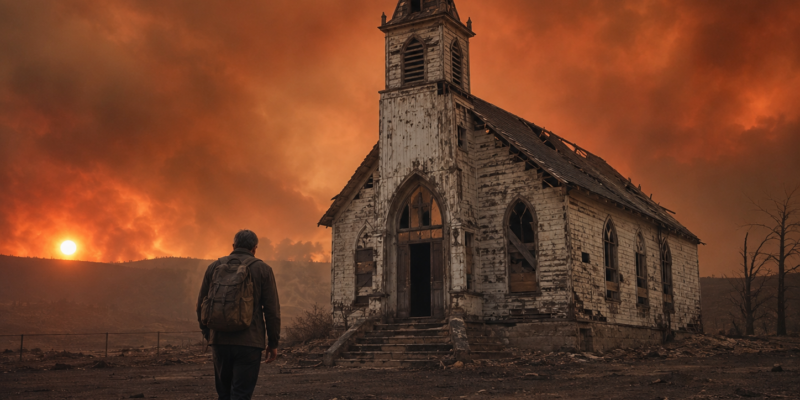
When an old belief collapses, the empty space can feel almost as frightening as the belief itself. Deconstruction may bring relief because questions that were once forbidden can finally be spoken. It may also bring grief. A familiar map has failed, while the next path remains hard to see.
The work that follows deserves as much care as the taking apart. Faith reconstruction is the patient practice of discerning what can carry truth, love, freedom, and responsibility. Christians have resources for that work: the life of Jesus, the fruits a belief produces, the promises of baptism, and practices that keep us in honest relationship with God and one another.
Leave the Rubble Where It Fell
Some teachings deserve to be released. A theology that requires someone to deny their dignity, silence their questions, accept abuse, or fear honest inquiry has already shown what it produces. Returning to it for the sake of familiarity will not make it trustworthy.
That recognition can carry sorrow. People may grieve a community, a vocation, a sense of certainty, or an image of God that once organized the whole world. Brian McLaren describes doubt as a passage that can lead toward a more mature and fruitful faith.1McLaren, B. D. (2021). Faith after doubt: Why your beliefs stopped working and what to do about it. St. Martin’s Essentials. Grief needs room. Reconstruction does not require a person to rush past loss or turn pain into a tidy testimony.
It also helps to distinguish God from the claims people have made about God. A human system can fail. A church can betray its calling. A biblical interpretation can be distorted by fear, prejudice, or the desire for control. Naming those failures truthfully can become an act of faith because truthfulness makes deeper relationship possible.
Test a Belief by Its Fruit
Reconstruction needs criteria. Otherwise, we may exchange one rigid system for another or treat personal comfort as the only measure of truth. Paul offers a concise discipline: “test everything; hold fast to what is good” (1 Thessalonians 5:21, NRSVue).2National Council of Churches of Christ in the United States of America. (2021). 1 Thessalonians 5:21. In New Revised Standard Version Updated Edition. Bible Gateway. https://www.biblegateway.com/passage/?search=1%20Thessalonians%205%3A21&version=NRSVUE
Testing asks more than whether a teaching can be defended with a verse. It examines the kind of life the teaching forms. Jesus says, “You will know them by their fruits” (Matthew 7:16, NRSVue).3National Council of Churches of Christ in the United States of America. (2021). Matthew 7:15–20. In New Revised Standard Version Updated Edition. Bible Gateway. Does this belief cultivate love, joy, peace, patience, courage, honesty, and justice? Does it help people become more accountable for harm? Does it deepen compassion for those whose lives differ from our own? Does it make room for evidence, correction, and growth?
Good fruit does not mean constant ease. Love can confront. Justice can disturb settled arrangements. Repentance can hurt. A fruitful faith tells the truth about harm and creates a path toward repair. It refuses cruelty even when cruelty is defended as conviction.
Rebuild Around Practices
Beliefs matter, yet faith becomes livable through practices. Rowan Williams identifies baptism, the Bible, Eucharist, and prayer as enduring elements of Christian life across wide differences in Christian thought and practice.4Williams, R. (2014). Being Christian: Baptism, Bible, Eucharist, prayer. William B. Eerdmans Publishing Company. These practices can offer a framework when a complete theological system no longer feels possible.
Prayer allows honesty before God, including anger, doubt, silence, and longing. Scripture places our questions inside a library filled with argument, lament, poetry, memory, and hope. Eucharist teaches dependence: we receive a gift we did not produce, alongside people we did not choose. Baptism gives identity before achievement and joins personal faith to a shared way of life.
The Episcopal baptismal covenant is especially useful for reconstruction because it joins conviction to practice. It asks us to continue in teaching, fellowship, breaking bread, and prayer; resist evil and return when we sin; proclaim good news; seek and serve Christ in all persons; and pursue justice, peace, and human dignity. The repeated response is “I will, with God’s help.”5The Episcopal Church. (1979). The Book of Common Prayer (pp. 304–305). Church Hymnal Corporation. https://www.episcopalchurch.org/wp-content/uploads/2023/06/book_of_common_prayer.pdf
That response makes room for humility. We make real commitments while acknowledging dependence on grace, community, and continuing transformation. A reconstructed faith can have structure without pretending to possess perfect certainty.
Choose a Community Capable of Repentance
Faith reconstruction is deeply personal, and it is rarely sustained alone. Community gives us companions, practices, inherited wisdom, and opportunities to serve. Community also carries risk. The question is whether a congregation can receive truth about itself.
A trustworthy church does more than advertise welcome. It has clear safeguards, accountable leadership, and ways to report harm. Leaders can apologize without centering their own intentions. Questions are treated as part of discipleship. LGBTQ people, disabled people, people of color, women, children, and survivors participate in shaping the common life. Authority is visible enough to be examined, and correction can lead to change.
No congregation will meet every hope. The standard is a community willing to practice repentance. In Christian life, returning after failure is central. A church that cannot acknowledge harm asks its members to carry a burden the institution refuses to bear.
Carry the Questions With You
Reconstruction does not end with a final, flawless statement of faith. Living relationships keep changing us. New knowledge, new neighbors, fresh encounters with Scripture, and the Holy Spirit’s movement can expose places where our theology remains too small.
This openness is compatible with commitment. We can follow Jesus while continuing to ask how faithfully we understand him. We can pray while admitting uncertainty about prayer. We can receive Eucharist while wrestling with the Church. We can make baptismal promises and return to them after failure.
A useful next step may be simple. Name one belief you can no longer carry. Name the fruit it produced. Then name one practice or conviction that still opens your life toward love of God and neighbor. Bring both truths into prayer, conversation, or the Eucharist. Reconstruction begins there: with honest discernment, shared practices, and the courage to hold fast to what is good.
References
- 1McLaren, B. D. (2021). Faith after doubt: Why your beliefs stopped working and what to do about it. St. Martin’s Essentials. ↩︎
- 2National Council of Churches of Christ in the United States of America. (2021). 1 Thessalonians 5:21. In New Revised Standard Version Updated Edition. Bible Gateway. https://www.biblegateway.com/passage/?search=1%20Thessalonians%205%3A21&version=NRSVUE ↩︎
- 3National Council of Churches of Christ in the United States of America. (2021). Matthew 7:15–20. In New Revised Standard Version Updated Edition. Bible Gateway. ↩︎
- 4Williams, R. (2014). Being Christian: Baptism, Bible, Eucharist, prayer. William B. Eerdmans Publishing Company. ↩︎
- 5The Episcopal Church. (1979). The Book of Common Prayer (pp. 304–305). Church Hymnal Corporation. https://www.episcopalchurch.org/wp-content/uploads/2023/06/book_of_common_prayer.pdf ↩︎